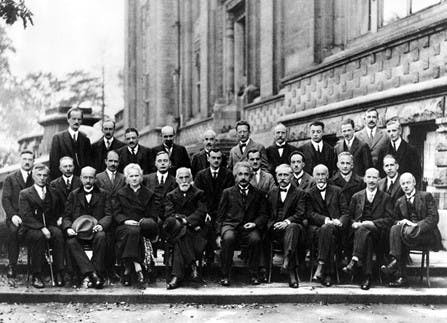
Quantum Computer Conference
Vienna University — View the full conference paper and presentation materials.
Exploring the fundamental laws that govern the universe. My work and teaching in physics bridge advanced mathematics with physical reality, covering everything from classical mechanics and thermodynamics to quantum computing and general relativity.
The universe is governed by four fundamental interactions: Gravitational (occurring between bodies with mass), Electromagnetic (acting between electric charges), Strong Nuclear (binding subatomic particles), and Weak Nuclear (responsible for radioactive decay).
Newton's three laws of motion describe the behavior of physical bodies when subjected to forces. They form the foundation of classical mechanics, explaining inertia, acceleration, and the principle of action and reaction.
The study of electromagnetic forces explains how electric currents and magnetic fields relate to one another, forming the basis for modern electronics, optics, and electrical engineering.
The four laws of thermodynamics define the fundamental physical quantities (energy, temperature, entropy) and explain how thermal energy interacts, behaves, and transfers within macroscopic systems.
Einstein's geometric theory of gravitation explains how the fabric of spacetime is curved by mass and energy, demonstrating how events and measurements differ depending on the observer's frame of reference.
The mathematical backbone of physics includes foundational equations governing speed, acceleration, weight, Ohm's Law, and frequency, allowing us to model and predict physical phenomena with precision.
Vienna University — View the full conference paper and presentation materials.